Search for a digital microscope price in India and the results run from a few thousand rupees to several lakhs. Both ends of that range are honestly labelled “digital microscope”, which tells you the term is doing far too much work.
It covers a plastic USB toy for a hobbyist. It also covers a trinocular laboratory instrument with a calibrated sensor and measurement software.
So before comparing prices, it helps to know what changes them.
What a digital microscope actually is
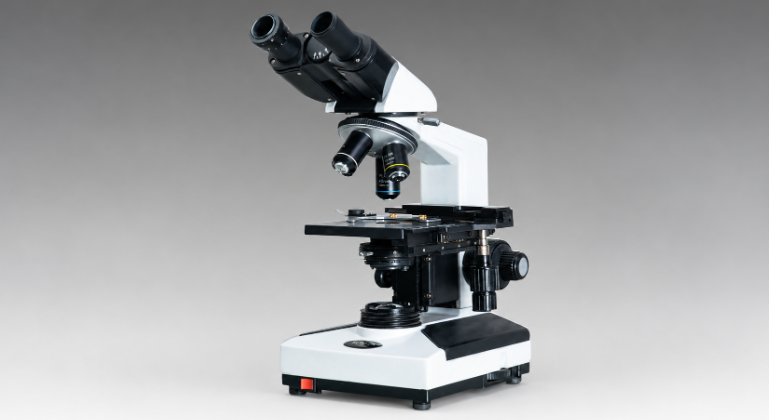
A digital microscope is a microscope with a camera sensor in the optical path, sending the magnified image to a monitor, computer or projector instead of, or alongside, an eyepiece. The image can be captured, stored, measured and shared.
There are two ways to get there, and they cost very differently. One is a fully integrated digital instrument with the camera built in. The other is a camera attachment fitted to the trinocular port of a microscope you already own.
That second route is the one most labs overlook. If the existing optics are sound, a camera head and software are often the entire upgrade — and the saving over a new instrument is substantial.
Sensor resolution: the largest single factor
Resolution decides how much detail survives into the captured image, and it drives price more than any other component.
For classroom demonstration and routine record keeping, a mid-resolution sensor is genuinely enough. The image goes on a screen, thirty students see it clearly, and nobody is measuring anything to a micron.
For publication imaging, fine measurement or pathology documentation, a higher-resolution sensor earns its cost. But it is worth being honest about which category you fall into, because paying for a sensor that outperforms the objectives in front of it changes nothing on screen.
Output type, and why it matters more than expected
A USB camera sends the image to a computer. HDMI sends it directly to a monitor without a computer in the loop. Some systems offer both.
The choice sounds technical and is really practical. A teaching lab with no computer at the bench wants HDMI. A pathology lab that stores images in case records wants USB and software. A QC bench that does both wants both, and paying for it once is cheaper than discovering the limitation later.
Software is where budgets get surprised
Basic capture software comes bundled with most cameras. Measurement, calibration, annotation and reporting features usually do not.
If your work involves stating a dimension — a particle size, a fibre diameter, a weld width — then calibrated on-screen measurement is not optional, and it is a real cost line. If your work is observation and teaching, it is not, and there is no reason to pay for it.
Ask what the software does before agreeing to the quotation. This is the most common place where a cheap system turns out to need an expensive addition.
Mounting, and the compatibility question
A camera has to physically fit the microscope and match the optical path, otherwise the image is cropped, vignetted or out of parfocal alignment with the eyepieces. Buying a camera from one seller and a microscope from another is where this goes wrong.
Manufacturers that build both can match them properly. SUSWOX, which has manufactured microscopes and camera systems in Ambala since 1973, supplies them as a matched setup for exactly this reason — the lab is not left working out C-mount adapters on its own.
Integrated unit or camera attachment?
Worth settling early, because it changes the budget by a large multiple.
An integrated digital microscope makes sense where no conventional instrument exists yet, or where the operator will never use an eyepiece — an inspection bench, a demonstration room. A camera attachment makes sense where good optics are already on the bench and only the imaging is missing, which describes most Indian labs that have been running ten years or more.
Check the head first. If it is trinocular, the cheaper route is probably open to you.
The accessories nobody quotes for
A digital setup usually needs a few things beyond the camera itself, and they rarely appear in the first quotation.
A calibration slide, if you intend to measure anything. A monitor or a computer capable of running the software without lag. Cabling long enough to reach where the screen will actually sit. And storage, because a lab capturing images daily fills a drive faster than expected and nobody plans for it.
These are small costs individually. Together they are enough to embarrass a budget that was approved to the rupee, so add them at the start.
So what should you budget?
Rather than a number, use this order. Decide the application. Decide whether you need a full instrument or only a camera for an existing trinocular microscope. Then decide the resolution, the output, and whether measurement software is genuinely required.
Send those four answers to a manufacturer and ask for a written quotation with GST and delivery timelines. A quotation built around your exact configuration is the only honest way to establish the digital microscope price in India for your lab, and it beats any range copied off a marketplace listing.
And if a quotation looks unusually low, check what is missing. Usually it is the software, the mount, or the warranty.
AUTHOR BIO (FOR THE PUBLISHING SITE)
Contributed by SUSWOX, a microscope and camera system manufacturer based in Ambala, Haryana, supplying laboratories and educational institutions since 1973.
NOTES
Good fit for technology, education technology, laboratory and science equipment blogs.
Keep the in-body link. Do not add a second link to the same domain unless the publisher allows it.
Original article, written for single publication.