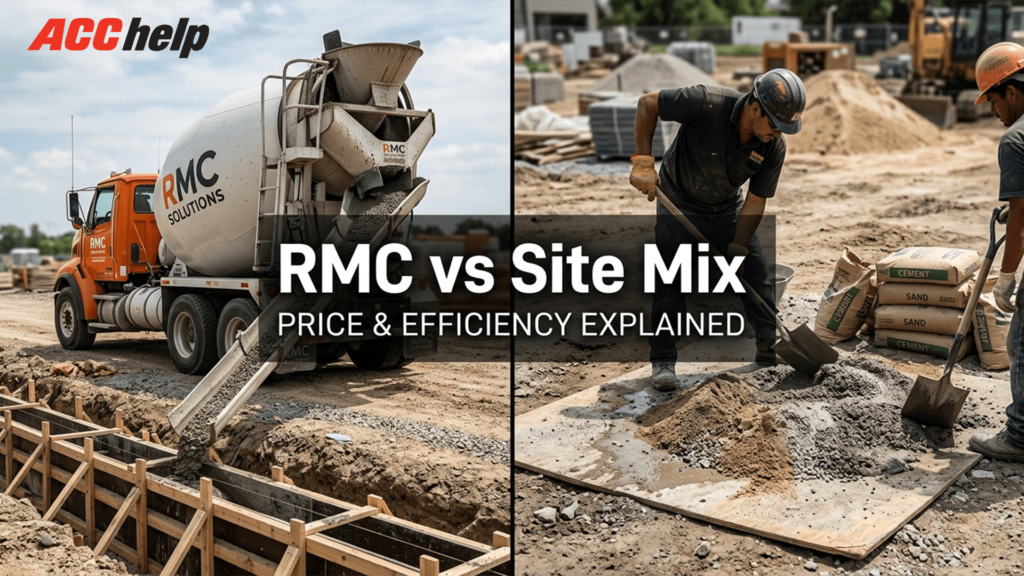
In the rapidly evolving construction landscape of 2026, the age-old debate between ready mix concrete and traditional site mixed concrete has taken a new turn. This is because urban spaces have shrunk and the demand for structural longevity grows, homeowners are increasingly looking towards industrial solutions.
The Hidden Math of Ready Mix Concrete Price
At first glance, the ready mic concrete price per cubic meter often appears higher than the combined cost of raw cement, sand and aggregate. However, this is a classic case of comparing apples to oranges. When you buy RMC, you aren’t just buying a product, you are buying a service and a scientific guarantee.
The price of RCM includes:
Precision Batching: Every gram of material is weighed by computerized sensors in a controlled factory environment.
Logistics: The cost of transport in specialized transit mixers that keep the concrete agitated and fresh.
Quality Assurance: Regular lab testing of raw materials and final cubes to ensure the strength matches the design requirements.
On the other hand, the cheaper site mix option carries several hidden costs. You have to account for the wastage of raw cement products, the rental cost of a mixer machine, the electricity or fuel to run it, and the massive labor force required to move materials manually.
Efficiency & Consistency
The greatest enemy of a strong house is human error. On a traditional site mix set up, the recipe for concrete is often left to the intuition of a mason. They might add a little extra water to make the concrete easier to pour or they might lose count of the number of basins of sand added to the mix.
In the construction industry, the water-cement ratio is very crucial. Even a slight excess of water can lead to honeycombing and microscopic voids in your slabs, which eventually manifest as seepage and structural cracks. RMC eliminates this risk. RMC is a batch calculated by a computer, the consistency of which is uniform from the first truck to the last.
Time is the most expensive material on your site. A standard 1,000 sq. ft. roof slab that might take an entire day to pour manually can be completed in under 3 hours using RMC and a concrete pump. This speed isn’t just about finishing early, it’s about structural health. Fast pouring prevents weakening of lines that form when a new batch of concrete is poured against a batch that has already started to set.
Navigating Specialized Cement Products
Ready mix concrete is available in a huge variety, categorized by its production method. These are chosen based on project requirements, transit time and site conditions, with common grades ranging from M10 to M45+ for varying strength needs.
| Category | Type | Description |
| Mixing Method | Central Method | Mixed 100% at the plant. |
| Transit Mixed | Mixed in the truck during transit | |
| Shrink Mixed | Partially mixed at the factory to reduce volume, while final mixing is done at the site | |
| Specialized | Self compacting concrete | Highly flowable concrete that fills complex formwork without vibration |
| Fiber reinforced concrete | Contains fiber to increase structural integrity and reduce cracking | |
| Pervious concrete | Porous mix that allows water to pass through, reducing surface runoff and puddling | |
| High strength concrete | Specialized mixes with high compressive strength for high rise buildings and bridges. | |
| Ice concrete | Uses ice or supercooled water to reduce heat, ideal for massive pours in hot water. |
When Should You Still Use Site Mix?
While RMC is superior for large scale structural elements, there is still a place for traditional cement products and site mixing.
- Small Scale Projects: For small scale masonry work, fixing a garden wall or minor internal renovations, the logistics of calling a transit mixer are not feasible. For these retail needs, buying high quality bags of concrete and mixing them on site remains the most cost effective method.
- Internal Renovations & Finishing: Site mixing is the only practical way to transport materials through narrow hallways and up stairs. It gives the masons the flexibility to mix small batches as they go, ensuring the mortar stays fresh for the specific task at hand.
- Remote or Inaccessible Locations: Remote locations like hillside or a narrow alleyway makes the transit mixer inaccessible. Therefore, site mixing allows you to transport raw cement products, sand and stone in smaller, more agile vehicles, and mix them right at the project site.
Takeaways
While the ready mix concrete price may seem like a larger up front hit to the budget, the long term ROI is undeniable. You save on labor, eliminate material wastage, accelerate your project, and most importantly, you ensure a level of structural consistency that manual mixing simply cannot replicate.
Your home is an investment that should last for generations. By choosing a brand that leads in both specialized cement products and RCM technology, you are ensuring that your sanctuary is built with the precision of a laboratory and the strength of a legend.