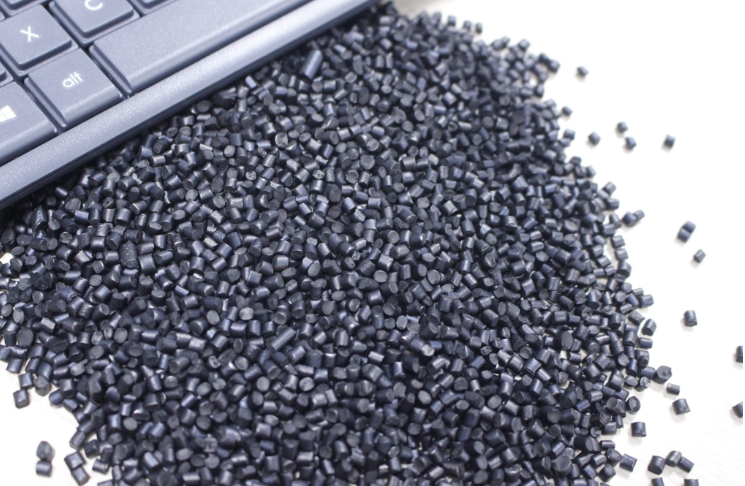
Plastic compounds are engineered materials, polymers blended with additives or fillers to deliver specific properties. Two examples with distinct roles are conductive compounds, designed to manage electricity, and PVC compounds, valued for versatility and durability. Comparing them shows how compound selection should follow the demands of the application.
What Are Conductive Compounds?
Ordinary plastics are insulators. Conductive compounds are formulated to conduct or dissipate electricity by incorporating conductive fillers such as carbon black, carbon fibres, or other conductive materials into a base polymer. Depending on the formulation, they can range from anti-static to electrically conductive behaviour.
They are used where controlling static or electricity matters:
• Electronic component packaging and trays
• Anti-static housings and enclosures
• ESD-protective parts for sensitive electronics
• Fuel-system and industrial components needing static dissipation
The degree of conductivity depends on filler type, loading, and dispersion. Higher conductivity often requires higher loading, which can influence mechanical properties and processing, so formulation involves balancing performance against these effects.
What Are PVC Compounds?
A PVC compound is polyvinyl chloride blended with additives such as plasticisers, stabilisers, lubricants, and fillers to achieve a target set of properties. PVC’s versatility comes from this formulation flexibility; it can be made rigid or flexible depending on the additive package.
Common applications include:
• Wire and cable insulation and sheathing
• Pipes and fittings
• Profiles and construction products
• Footwear and consumer goods
Rigid PVC suits pipes and profiles, while flexible PVC suits cables and hoses. The additive system determines where a given compound fits.
Comparing Their Roles
| Aspect | Conductive Compounds | PVC Compounds |
| Primary function | Manage electricity/static | Versatile structural material |
| Key ingredients | Conductive fillers | Plasticisers, stabilisers, fillers |
| Typical uses | Electronics, ESD parts | Cables, pipes, profiles |
| Selection driver | Required conductivity level | Rigid vs flexible, end-use needs |
The two are not competing choices; they serve different needs. A cable, however, might use both, a PVC-based sheath in some designs alongside conductive elements elsewhere in the assembly.
How Buyers Evaluate Compound Requirements
Selecting the right compound is a matter of defining requirements precisely:
• Performance target: For conductive compounds, the required conductivity or static-dissipation level. For PVC, the balance of flexibility, strength, and durability.
• Processing method: Extrusion, injection moulding, or other, since compounds behave differently.
• End-use environment: Temperature, mechanical stress, and any regulatory needs.
• Consistency: Batch-to-batch reliability, critical for both electrical performance and mechanical properties.
Because behaviour depends on formulation, dosage, and processing, sampling and validation are essential before committing to volume.
Processing and Practical Notes
Conductive compounds can be sensitive to dispersion; uneven filler distribution leads to inconsistent electrical performance. PVC processing depends heavily on stabiliser and plasticiser selection, and temperature control is important to avoid degradation. In both cases, working with a supplier who understands the specific compound helps prevent common defects.
Frequently Asked Questions
Are all conductive compounds fully conductive?
No. They range from anti-static to conductive depending on filler type and loading.
Can PVC be both rigid and flexible?
Yes. The additive package, particularly plasticiser content, determines rigidity or flexibility.
What is the most important selection factor?
A clear performance target matched to your processing method and end-use, validated through trials.
Conclusion
Conductive compounds and PVC compounds occupy different roles: one manages electricity, the other offers broad structural versatility. Choosing well means defining your performance target, processing method, and end-use conditions, then confirming consistency through sampling. Precise requirements and supplier collaboration lead to a compound that performs reliably in the application.