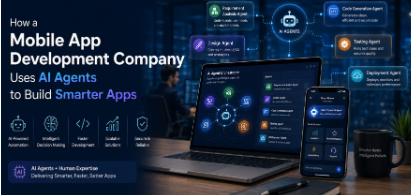
Nina Castillo had been managing product for a fintech startup for three years when she noticed something her analytics dashboard couldn’t explain. User retention dropped sharply between day seven and day fourteen for almost every cohort, regardless of acquisition channel or user segment. The app worked. Onboarding tested well. But something in the second week was pushing people out. Her team ran surveys, dug through session recordings, and ran A/B tests on three different onboarding variations. None of it moved the number. It wasn’t until she brought in a Mobile App Development Company with a dedicated AI practice that the pattern finally surfaced: users who hadn’t connected a secondary bank account by day five almost never came back after day twelve, and the app was doing nothing to recognize or respond to that signal in real time. The fix wasn’t a redesign. It was an AI agent that watched for that behavioral pattern and delivered a perfectly timed, contextually relevant nudge at exactly the right moment. Retention for the at-risk segment improved by 34% within eight weeks. That outcome is what the shift toward AI agents in app development actually looks like in practice: not science fiction, but quiet, specific intelligence applied to problems that data alone couldn’t solve.
What AI Agents Actually Are Inside a Mobile App
The term AI agent gets used loosely enough that it’s worth grounding before going further. In the context of mobile app development, an AI agent is a system that perceives its environment, makes decisions based on defined goals, takes actions, and adjusts its behavior based on outcomes. It operates autonomously within set parameters, which separates it from a rule-based automation or a static recommendation engine.
A simple push notification sent to all users at 9 AM is automation. An AI agent that monitors individual user behavior, identifies the moment a specific user is most likely to engage based on historical patterns, selects the message most relevant to their current position in the product journey, and adjusts its model based on whether that user responded is a fundamentally different category of system. The distinction matters because the outcomes are different. Automation scales what you already know. Agents discover what you don’t.
Personalization That Goes Beyond Surface-Level Customization
Most mobile apps that claim personalization are doing segmentation. Users get grouped by broad characteristics, and each group receives a slightly different experience. That approach has value, but it has a ceiling, because two users in the same segment can have completely different needs, contexts, and behavioral histories.
AI agents operate at the individual level. A fitness app that uses an agent to manage workout recommendations isn’t showing the same plan to everyone who selected “weight loss” during onboarding. It’s watching how a specific user actually trains: which sessions they complete, which ones they skip, how their performance changes across different times of day, how they respond to different difficulty levels. The agent builds a model of that individual and updates it continuously. Recommendations six weeks in reflect six weeks of observed behavior, not a static profile set at signup.
A health and wellness platform rebuilt its content recommendation layer using an agent architecture and saw average session duration increase by 22% within the first month. The agent wasn’t serving more content. It was serving more relevant content, which reduced the friction users experienced when trying to find something worth engaging with.
Autonomous Testing and Quality Assurance
Building smarter apps isn’t only about what users experience. It’s also about how the app gets built. AI agents are changing quality assurance by moving it from a discrete phase of the development cycle to a continuous process that runs alongside development in real time.
Traditional QA relies on test suites written by engineers, executed on a schedule, and interpreted by testers who triage failures. That process finds what the test suite covers. It misses edge cases nobody thought to write tests for, and it operates too slowly to keep pace with modern release cadences.
Agent-based testing systems explore an application the way a user would, but at machine speed and without the bias of familiarity. They find interaction sequences that human testers don’t try because they seem unlikely, and they generate bug reports with reproducible steps automatically. A development team that integrated an autonomous testing agent into its CI/CD pipeline reduced the time between code commit and verified test coverage from 72 hours to under four. The agent also identified a class of crashes triggered by a specific sequence of rapid-fire taps that no manual tester had ever produced deliberately.
Context-Aware Decision Making in Real Time
The most powerful thing an AI agent can do inside a mobile app is make decisions in real time based on context that changes moment to moment. That capability opens product possibilities that static logic simply cannot support.
A travel app built an agent that managed dynamic pricing displays, itinerary suggestions, and upgrade prompts based on a continuously updated model of each user’s trip context: destination, time until departure, weather at the destination, previous booking behavior, and current in-app browsing session. The agent wasn’t running a rules engine. It was making judgment calls about what to surface and when, based on dozens of signals simultaneously.
Conversion on upsell prompts increased by 19% compared to the previous rule-based system. The agent generated no more prompts than the old system. It generated better-timed ones, which is a different thing entirely.
Integration With Large Language Models for In-App Intelligence
The emergence of capable large language models has given development teams a new layer to work with. AI agents that can call an LLM as part of their decision process bring natural language understanding into app interactions that previously required structured inputs and rigid UI flows.
A legal document management app built an agent that let users describe what they were looking for in plain language. Someone typing “find the indemnification clause in the Reyes contract from March” got a precise result rather than a keyword search return with fifty results to sift through. The agent parsed the query, identified the relevant entities, called the appropriate retrieval system, and presented the result in context without requiring the user to understand how the underlying search worked.
That kind of interaction requires an agent that can interpret intent, manage the retrieval process, handle ambiguity gracefully, and present results in a way that matches the user’s framing. None of those steps are possible with conventional search logic. The LLM provides the language understanding; the agent orchestrates the workflow around it.
The Development Implications of Building Agentic Apps
Shipping an app with embedded AI agents requires different architectural thinking than shipping a conventional mobile application. Agents need data pipelines that feed them current behavioral signals. They need feedback loops that let model performance be monitored and improved over time. They need guardrails that prevent autonomous behavior from producing outcomes the product team didn’t intend.
That last point is often underestimated. An agent optimizing for engagement without guardrails on what kinds of engagement count can find patterns that increase time in app while degrading user experience in ways that don’t show up immediately in the metrics being tracked. Building responsible agent architecture means defining what the agent is optimizing for carefully, what constraints bound its behavior, and what human review processes exist for auditing decisions at scale.
Development teams building agentic apps are increasingly treating model evaluation as a product discipline rather than an engineering afterthought. The questions being asked aren’t just “does the agent work?” but “is the agent working for the right reasons, toward the right outcomes, in ways the team can actually understand and explain?”
What Nina’s Fintech Tells the Broader Story
Nina’s retention problem got solved by a relatively narrow agent doing one thing well: monitoring a behavioral pattern, making a judgment about timing, and acting on it. The sophistication wasn’t in the technology alone. It was in the clarity about what problem needed solving and the precision of how the agent was scoped to solve it.
That’s the consistent pattern across the best AI agent implementations in mobile apps right now. The teams getting the most out of this technology aren’t the ones deploying the most complex systems. They’re the ones who identified a specific gap where autonomous, context-aware decision making would outperform what static logic or human intervention could achieve, and then built tightly toward that gap. Smarter apps aren’t built by adding intelligence everywhere. They’re built by adding it exactly where it changes something that matters.