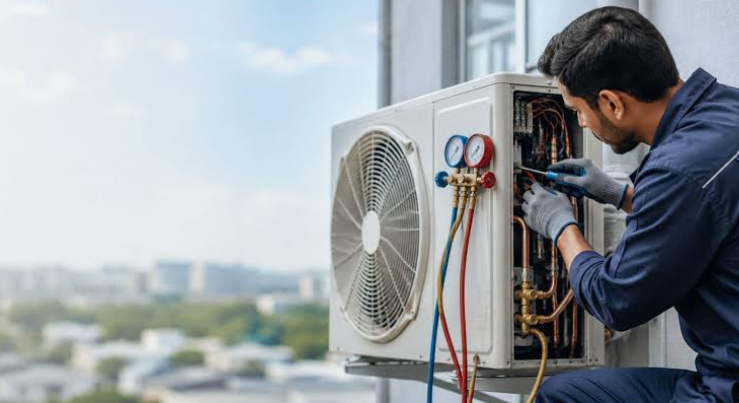
An air conditioner rarely fails without warning. It usually complains for days or weeks first, through weaker cooling, odd sounds, or a creeping electricity bill, before it finally gives up on the hottest afternoon of the year. People who learn to read these early signals get their units fixed cheaply and on their own schedule. People who ignore them end up paying more, in a queue, during a heatwave.
This article explains the warning signs worth acting on, what they usually mean, and why a surprising number of “AC faults” are actually electrical problems in disguise.
The Early Signs Worth Acting On
Weak cooling is the most common signal and the most misread. When a room takes longer to cool than it used to, something has changed, and it is worth diagnosing rather than tolerating. The cause might be a dirty filter, a refrigerant leak, or a struggling compressor, and these have very different fixes and costs.
Other signals are more specific. Water leaking from the indoor unit usually points to blocked drainage. Unusual noises, grinding, rattling, or buzzing, suggest a mechanical or electrical problem that will worsen if ignored. A musty smell when the unit runs often means mould in a damp, dirty system. And a sudden rise in the electricity bill, with no change in usage, is the unit telling you it is working harder than it should.
Why Early Repair Saves Money
The economics of AC repair reward early action. A small problem caught early, a clogged filter, a minor leak, or a loose connection is cheap and quick to fix. Left alone, that same problem often cascades. A refrigerant leak that goes unaddressed makes the compressor overwork, and a failed compressor is one of the most expensive repairs an AC can need.
Consider a unit that starts cooling weakly in April. Fixed then, it is a minor job. Ignored through a hard summer of daily use, the strain can turn a simple fault into a major failure by July. The cost difference between these two outcomes is large, and it comes down entirely to how quickly the early sign was acted upon. Timely air conditioner repair service in Gurgaon is almost always cheaper than the breakdown it prevents.
When the AC Is Not Really the Problem
Here is what many people miss: a large share of apparent AC faults are actually electrical. An air conditioner is a heavy load, and it depends on sound wiring, an adequate circuit, and a solid connection point. When any of these is weak, the symptoms look exactly like an AC problem.
A unit that trips the breaker, cuts out intermittently, or fails to start might have nothing wrong with the air conditioner itself. The real culprit could be an overloaded circuit, a loose connection, or undersized wiring. Repeatedly calling an AC technician for what is really a wiring fault wastes money and never fixes the underlying issue.
Why Electrical Diagnosis Matters
Because cooling and electrical supply are so intertwined, diagnosing an intermittent AC problem often means looking at the wiring, not just the unit. A qualified electrical professional can check whether the circuit is adequate, the connections are sound, and the load is properly supported. For homes in the capital, engaging a competent electrical service in delhi to inspect the point feeding a troublesome AC frequently reveals the real cause when the unit itself keeps testing fine.
This matters because the two trades solve different problems. An AC technician fixes the appliance; an electrician fixes the supply. Knowing which one you actually need saves both money and repeated visits. When an AC keeps tripping despite testing healthy, the answer usually lies in the wiring.
Building a Simple Habit of Attention
You do not need technical knowledge to catch problems early, only the habit of noticing. Pay attention to how quickly rooms cool, listen for new sounds, watch for leaks and smells, and keep a rough sense of your electricity bill from month to month. Any sudden change is worth a closer look.
This light attention costs nothing and catches most problems while they are still small and cheap. It is the single most effective thing a homeowner can do to avoid expensive breakdowns.
Practical Recommendations
Treat weak cooling as a signal to diagnose, not something to endure. Act on leaks, noises, smells, and bill spikes early, while the fix is still small. Recognise that tripping and intermittent cut-outs are often electrical rather than AC faults. Get the wiring checked when an AC keeps failing despite testing fine. And build the simple habit of noticing changes, which catches most problems before they escalate.
An air conditioner that fails in peak summer almost always gave warnings first. The difference between a cheap fix and an expensive emergency is usually just how early someone chose to listen.
FAQs
What is the most common early sign of an AC problem?
Weak cooling is the most frequent signal. It has several possible causes, so it is worth diagnosing rather than ignoring or reflexively refilling gas.
Why does my AC keep tripping the breaker?
Frequent tripping is often an electrical issue rather than an AC fault, such as an overloaded circuit or a loose connection. The wiring should be checked if the unit itself tests fine.
Is early repair really cheaper?
Usually, yes. Small faults caught early are quick and inexpensive, while the same faults left alone can cascade into major repairs like compressor failure.
How do I know whether I need an AC technician or an electrician?
If the unit cools poorly or leaks, it is likely an AC issue. If it trips, cuts out, or won’t start while testing fine, the supply and wiring are the more likely cause.